


 Current
location:
Current
location:HM Instruments Dispensing Station Industry Application Whitepaper
Manual pipetting remains the default liquid handling method in many laboratories, yet its variability is expensive. An analysis published in PLOS Biology estimated that irreproducible preclinical research costs approximately $28 billion per year in the United States alone, with manual liquid handling errors among the contributing factors. Automated dispensing addresses this problem at its root: a peristaltic-pump dispensing station repeats the same volume thousands of times with a defined, verifiable error budget. This whitepaper examines how HM Instruments HM-F1 (single-channel) and HM-F8 (8-channel) dispensing stations serve five major application areas, and maps each workflow to the model that fits it best.
Application 1: Molecular Biology — PCR Setup, cDNA Libraries, Nucleic Acid Extraction
PCR-based workflows punish volume inconsistency. A 1 μL deviation in a 20 μL master mix aliquot changes reagent concentration by 5%, enough to shift Ct values and produce false-negative calls in low-copy assays. The HM-F1, with its single-channel YZ-15A pump head and accuracy of ≤5 μL at 50 μL, is the natural fit for preparing and aliquoting master mixes, distributing extraction reagents into lysis plates, and building cDNA libraries in tube strips where volumes vary well by well.
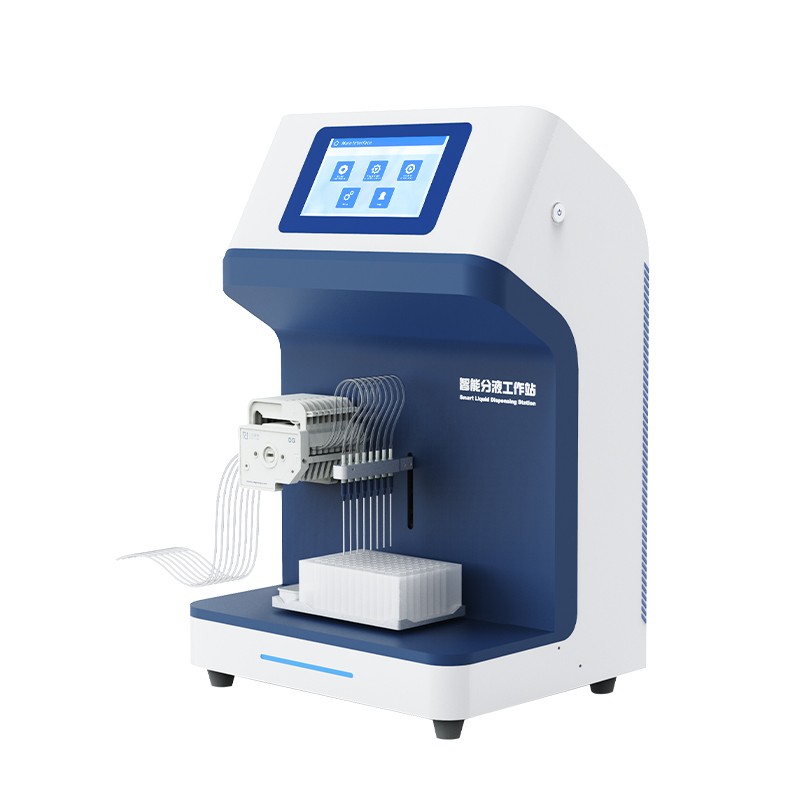
When the workload shifts to filling entire 96-well PCR plates with a uniform reaction mix, the HM-F8 completes a plate in a fraction of the time a single channel requires. Its programmed quantitative mode stores 10 recipes with up to 32 column volumes each, so a laboratory can keep a "qPCR plate" recipe permanently on the 7-inch touchscreen and recall it with two taps. Because peristaltic dispensing is non-contact, amplicon carryover between plates is eliminated by simply replacing the tubing.
Application 2: Cell Culture — Media Supplementation, Suspension Dispensing, Microplate Seeding
Cell culture liquid handling has two conflicting demands: gentleness for live cells and speed for routine feeding. The HM Instruments platform resolves both through multi-level adjustable dispensing strength — operators lower the flow intensity when dispensing cell suspensions to protect viability, and raise it for bulk media work.
- Microplate seeding: the HM-F8 distributes cell suspensions across 96-well plates through all eight channels, keeping cell density uniform from well A1 to H12. The adjustable needle rack (up to 15 mm spacing) matches standard plate geometry.
- Media supplementation in flasks and bottles: the HM-F1's single needle reaches into T-flasks and reagent bottles of varying neck sizes, dispensing precise supplement volumes at ≤5 μL accuracy (@50 μL) without moving vessels to a shared reservoir.
- Continuous-flow media preparation: constant-flow mode (unlimited volume) turns either model into a benchtop media dispenser for batch preparation.
Application 3: Drug Screening — High-Throughput Compound and Reagent Distribution
Screening facilities measure productivity in plates per day. The HM-F8 addresses this directly: eight parallel channels at 600 rpm pump speed and 50 mm/s linear speed fill a 96-well plate in seconds, and column-by-column programming supports dose-response layouts where each column receives a different volume. For 384-well formats, any-column dispensing mode lets operators address the plate in quadrants, while the HM-F1 handles hit-picking and cherry-picking tasks where individual wells need unique volumes.
Reagent economics matter at screening scale. The back-suction recovery function pulls unused reagent from the tubing back into the source container after a run — meaningful when a single compound library plate consumes microliters of high-value screening reagent. Maximum quantitative volume of 9,999,999 μL per recipe means even large assay batches run unattended.
Application 4: Clinical Laboratory Testing — Serum/Plasma Aliquoting and ELISA Sample Processing
Clinical workflows are dominated by aliquoting and immunoassay preparation. Both HM Instruments models meet the calibration requirements of JJF 1259-2018 (medical injection and infusion pumps) and JJF (Ji) 233-2024 (automatic pipetting workstations), giving laboratory directors a documented metrological basis for method validation under quality frameworks such as ISO 15189.
For serum and plasma aliquoting, the non-contact peristaltic design eliminates the cross-contamination risk that shared-tip systems carry: each sample batch runs through fresh platinum-cured silicone tubing (rated -51 to 238°C). In ELISA workflows, the HM-F8 adds coating, blocking, and substrate reagents to 96-well plates with ≤10 μL accuracy at 50 μL, while the HM-F1 handles standard curve serial dilutions where each tube receives a different, precisely defined volume. The removable waste-liquid tank connects to a drain line, so wash and prime cycles never require manual emptying mid-run.
Application 5: Industrial Quality Inspection — Standard Solutions and Trace Additive Dosing
QC laboratories in food, chemical, and environmental testing prepare standard solutions daily. Here the HM-F1 is the workhorse: dispensing precise spike volumes into volumetric flasks and vials at ≤5 μL accuracy (@50 μL) tightens calibration curves and reduces out-of-spec investigations. For production-side tasks such as dosing trace additives into batch containers, the constant-flow mode delivers unlimited volume at 600 rpm, while the 100 W DC 24 V supply and sub-60 dB operation keep the unit suitable for production-floor installation.
Facilities operating under ISO/IEC 17025 can incorporate the HM-F1 and HM-F8 into their measurement traceability chain, since both models ship with calibration against national JJF specifications that can be re-verified in-house using the gravimetric approach of ISO 8655.
Application-to-Model Summary
| Industry | Typical Task | Recommended Model | Key Capability |
|---|---|---|---|
| Molecular biology | PCR master mix, extraction reagents, cDNA libraries | HM-F1 (precision) / HM-F8 (plates) | ≤5 μL @50 μL; 10-recipe memory |
| Cell culture | Plate seeding, media feeding, suspension dispensing | HM-F8 (seeding) / HM-F1 (flasks) | Adjustable dispensing strength; constant-flow mode |
| Drug screening | 96/384-well reagent addition, dose-response layouts | HM-F8 | 8 channels; per-column programming; reagent recovery |
| Clinical testing | Serum/plasma aliquoting, ELISA processing | HM-F8 (ELISA) / HM-F1 (dilutions) | Non-contact fluid path; JJF-calibrated |
| Industrial QC | Standard solutions, trace additive dosing | HM-F1 | ≤5 μL accuracy; unlimited constant-flow volume |
Conclusion
Across all five application areas, the pattern is consistent: the HM-F1 wins where absolute accuracy and vessel flexibility matter most, and the HM-F8 wins where plates and throughput dominate. Many laboratories deploy both — the F1 for method development and standards, the F8 for routine batch processing. Full technical specifications are available on the HM-F1 and HM-F8 product pages, and answers to common engineering questions are collected in our dispensing station technical FAQ.
Article address:https://www.labinstruments.net/news/dispensing-station-industry-application-whitepaper.html