



 Current
location:
Current
location:HM Instruments Dispensing Station Cost-Performance Review: HM-F1 and HM-F8
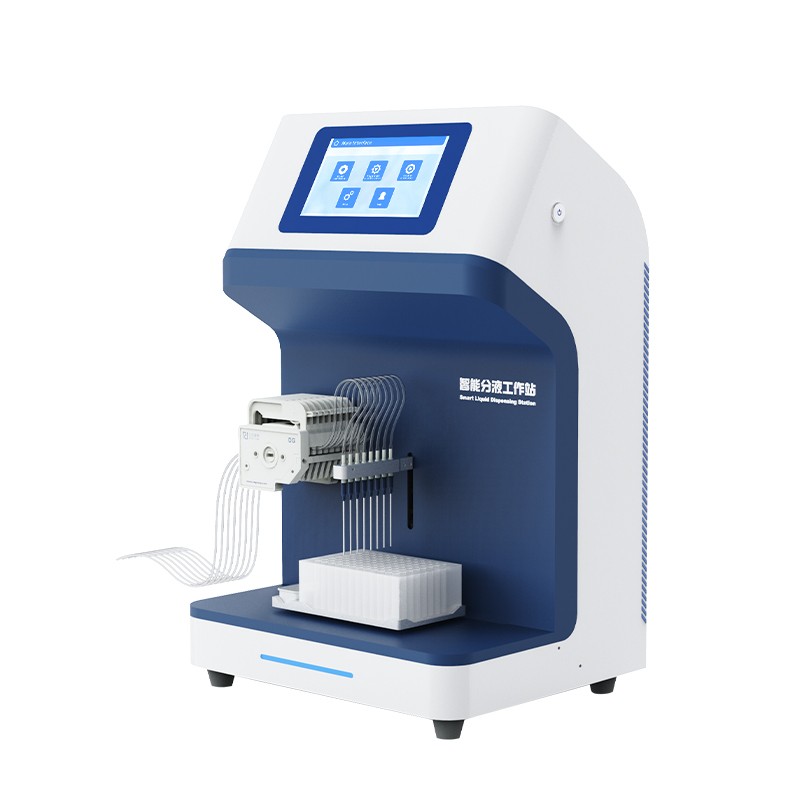
"Value for money" in liquid handling is often reduced to the sticker price — a mistake that costs laboratories dearly over a five-year ownership horizon. A rigorous cost-performance assessment must weigh accuracy, throughput, consumable lock-in, and service coverage together. This review evaluates the HM Instruments HM-F1 (single-channel, $2,687) and HM-F8 (8-channel, $3,284) automatic micro dispensing stations against the international brands most frequently shortlisted alongside them — Integra, Eppendorf, and Thermo Scientific — using published specifications and total cost of ownership (TCO) logic. Full product data is available on the HM-F1 and HM-F8 product pages.
Evaluation Methodology
We score each platform on four weighted dimensions:
- Dispensing performance (35%) — accuracy at microliter volumes, minimum dispensing volume, channel configuration.
- Throughput and automation depth (25%) — plate handling, programmability, dispensing modes.
- Operating cost (25%) — proprietary consumables, tubing versus tips, maintenance parts.
- Service and longevity (15%) — warranty, response time, spare-parts availability.
Accuracy claims are anchored to verifiable standards: the HM Instruments models are calibrated to JJF (Ji) 233-2024 and JJF 1259-2018, and can be independently checked using the gravimetric method defined in ISO 8655 — the same metrological basis used by premium international brands.
Specification Comparison
| Parameter | HM-F1 | HM-F8 | Integra VIAFLO 96 | Eppendorf epMotion 96 | Thermo Multidrop Combi |
|---|---|---|---|---|---|
| Channels | 1 | 8 | 96 (electronic pipette) | 96 (pipetting head) | 8 (cassette) |
| Working principle | Peristaltic pump | Peristaltic pump | Air displacement | Air displacement | Peristaltic pump |
| Minimum volume | 20 μL | 20 μL | 0.5 μL | 1 μL | 0.5 μL |
| Accuracy @50 μL | ≤5 μL | ≤10 μL | ≈±1–2% | ≈±1–2% | ≈±2–5% |
| Consumables | Silicone tubing only | Silicone tubing only | Proprietary tips | Proprietary tips | Proprietary cassettes |
| Typical street price | $2,687 | $3,284 | $7,000–$9,000 | $20,000+ | $10,000+ |
Note: competitor prices are indicative market ranges from public distributor listings; verify with local quotes. The HM Instruments prices are factory list prices.
Where the HM-F1 and HM-F8 Win
1. Consumable cost approaches zero
Air-displacement systems (Integra, Eppendorf) consume a pipette tip for every dispense or every plate row — at screening scale this is the dominant operating expense, often exceeding $1,000 per year per instrument. The Multidrop's peristaltic cassettes are cheaper per run but still proprietary. Both HM Instruments models dispense through standard platinum-cured silicone tubing (rated -51°C to 238°C) that costs a fraction of a tip box and is sterilizable by autoclave. Over five years, this single difference typically saves more than the entire purchase price of the instrument.
2. Non-contact fluid path eliminates cross-contamination
Because liquid only ever touches the tubing, there is no internal fluid path to clean and no shared-tip carryover. For PCR setup and clinical aliquoting — the two workflows most sensitive to contamination — this architecture is a structural advantage, not a feature checkbox.
3. Precision that covers the core workload
At 50 μL, the HM-F1's ≤5 μL and the HM-F8's ≤10 μL accuracy bands sit within the acceptance criteria of the vast majority of routine protocols (ELISA, media dispensing, reagent bottling, master mix distribution). Sub-μL accuracy remains the exclusive domain of air-displacement platforms — laboratories that genuinely need to dispense 0.5–5 μL should still budget for them. The honest conclusion: HM Instruments covers the 20 μL–10 mL window where 80% of daily dispensing actually happens, at a fifth of the price.
4. Programmability without a PC
The 7-inch touchscreen stores 10 recipes with up to 32 column volumes each, supporting whole-plate, any-column, and per-well (HM-F1) strategies plus quantitative (up to 9,999,999 μL) and constant-flow modes. Competing platforms at this price point typically offer fixed-volume bottletop dispensers with no programmability at all.
Where International Brands Still Lead
- Sub-microliter dispensing: Integra and Eppendorf reach 0.5–1 μL minimum volumes; HM Instruments starts at 20 μL.
- Full deck automation: epMotion offers robotic tip handling, plate grippers, and LIMS integration; the HM platform is a dispensing station, not a robotic workstation.
- Global service footprint: premium brands maintain direct service organizations in more countries, although HM Instruments counters with 280 service outlets across China's 31 provinces, 24-hour response, and a 10-year spare-parts guarantee after discontinuation.
Five-Year TCO Model (Illustrative)
| Cost item | HM-F8 | Integra VIAFLO 96 | Eppendorf epMotion 96 |
|---|---|---|---|
| Instrument | $3,284 | $8,000 | $22,000 |
| Consumables (5 yrs, moderate use) | ≈$500 (tubing) | ≈$5,000 (tips) | ≈$6,000 (tips) |
| Maintenance & service (5 yrs) | ≈$300 (year-1 warranty incl.) | ≈$2,500 | ≈$5,000 |
| Estimated 5-year TCO | ≈$4,100 | ≈$15,500 | ≈$33,000 |
Even under conservative assumptions, the HM-F8's five-year cost is roughly one quarter of an Integra-based workflow and one eighth of an epMotion-based one — while delivering accuracy within the tolerance band of routine protocols.
Verdict
The HM-F1 and HM-F8 are not universal replacements for premium robotic platforms — nor do they claim to be. They are precision dispensing stations that cover the 20 μL-and-up workload of molecular biology, cell culture, clinical, and QC laboratories with verifiable accuracy, near-zero consumable cost, and a TCO that air-displacement systems cannot match in this volume range. For laboratories whose dispensing needs start at 20 μL, HM Instruments delivers comparable core performance at 20–30% of the total cost — the definition of cost-performance leadership. For application-level details, see our industry application whitepaper, and for engineering answers consult the technical FAQ.
Article address:https://www.labinstruments.net/news/dispensing-station-cost-performance-review.html