

 Current
location:
Current
location: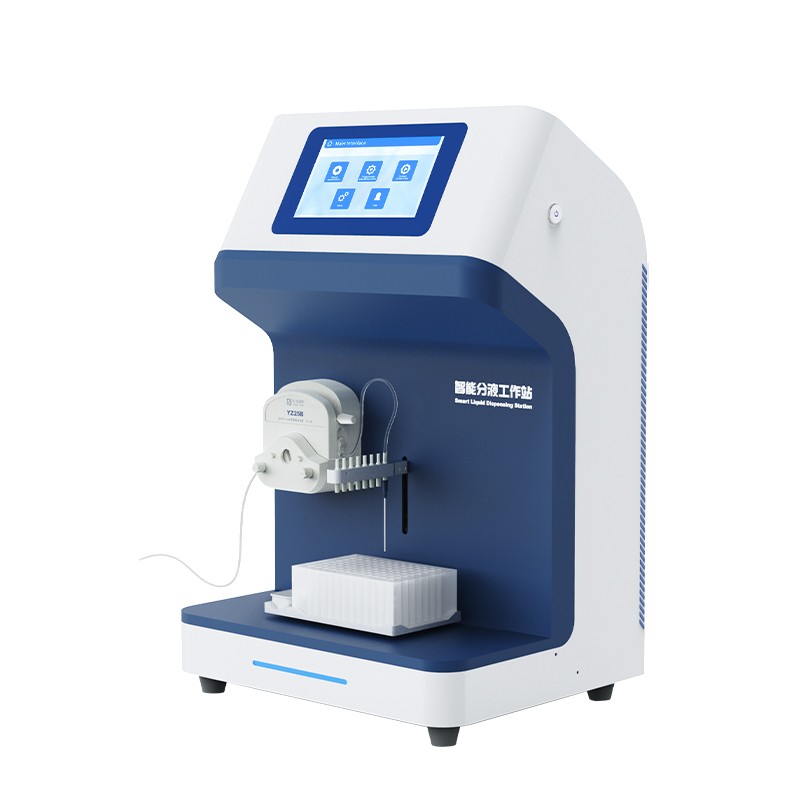
 +86 17853698681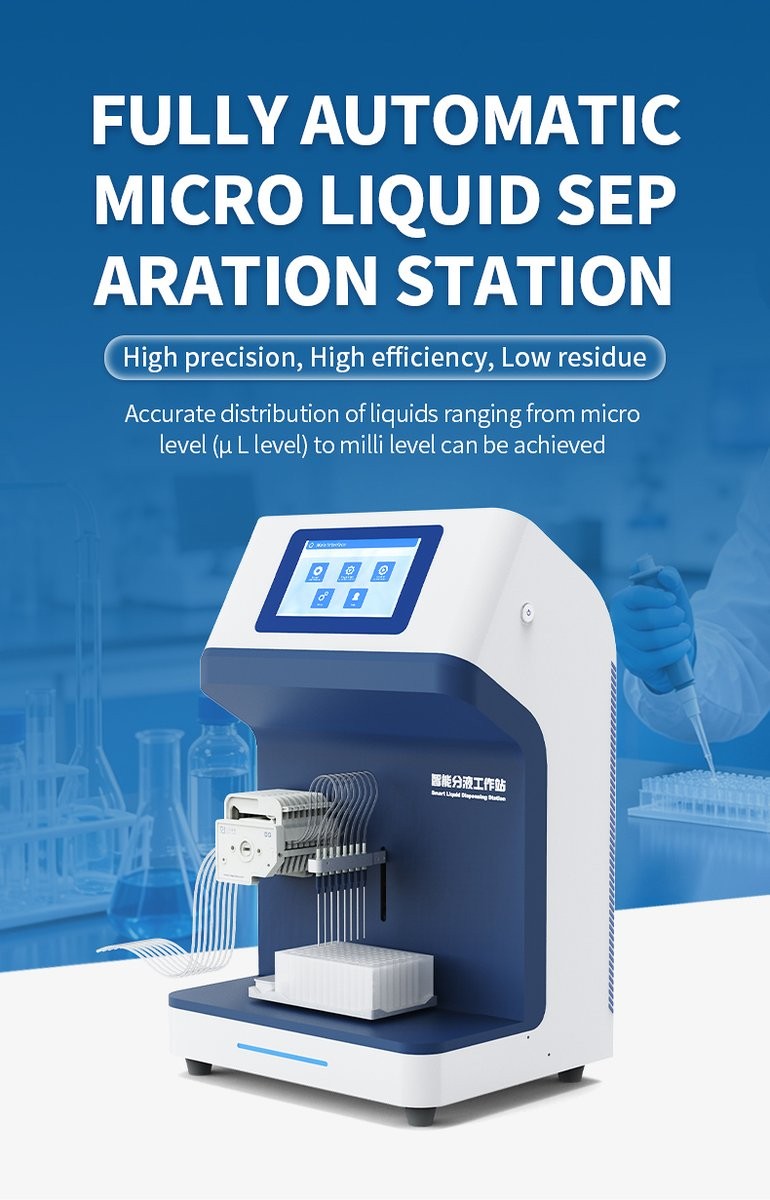
Product Introduction
In analytical and research laboratories, the most consequential dispensing errors happen at small volumes: a 1 μL deviation in a 20 μL master mix aliquot shifts reagent concentration by 5%, enough to move qPCR Ct values or bend a calibration curve out of specification. Manual pipetting at these volumes depends on operator technique, fatigue, and environmental conditions — variables that quality frameworks such as ISO/IEC 17025 and ISO 15189 expect laboratories to engineer out of their processes.
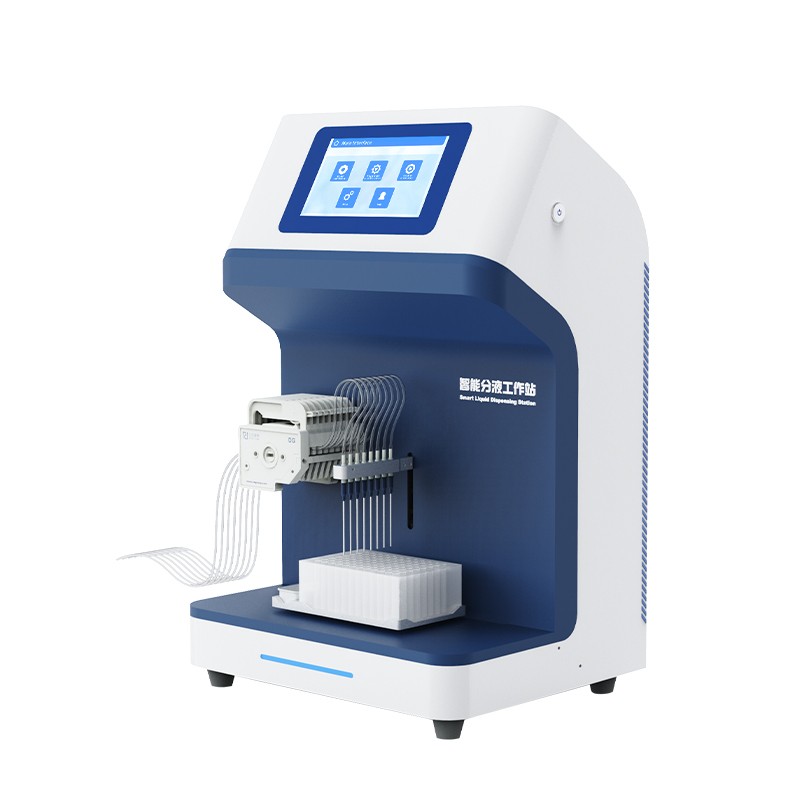
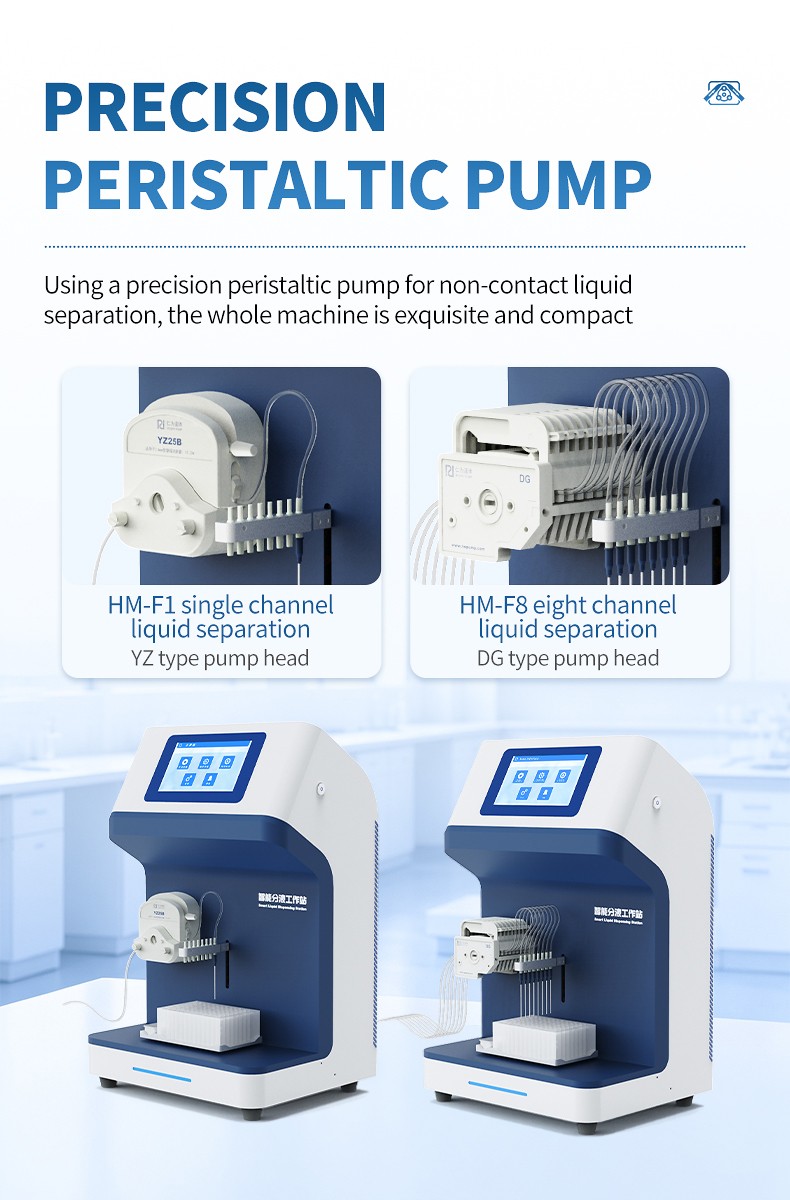
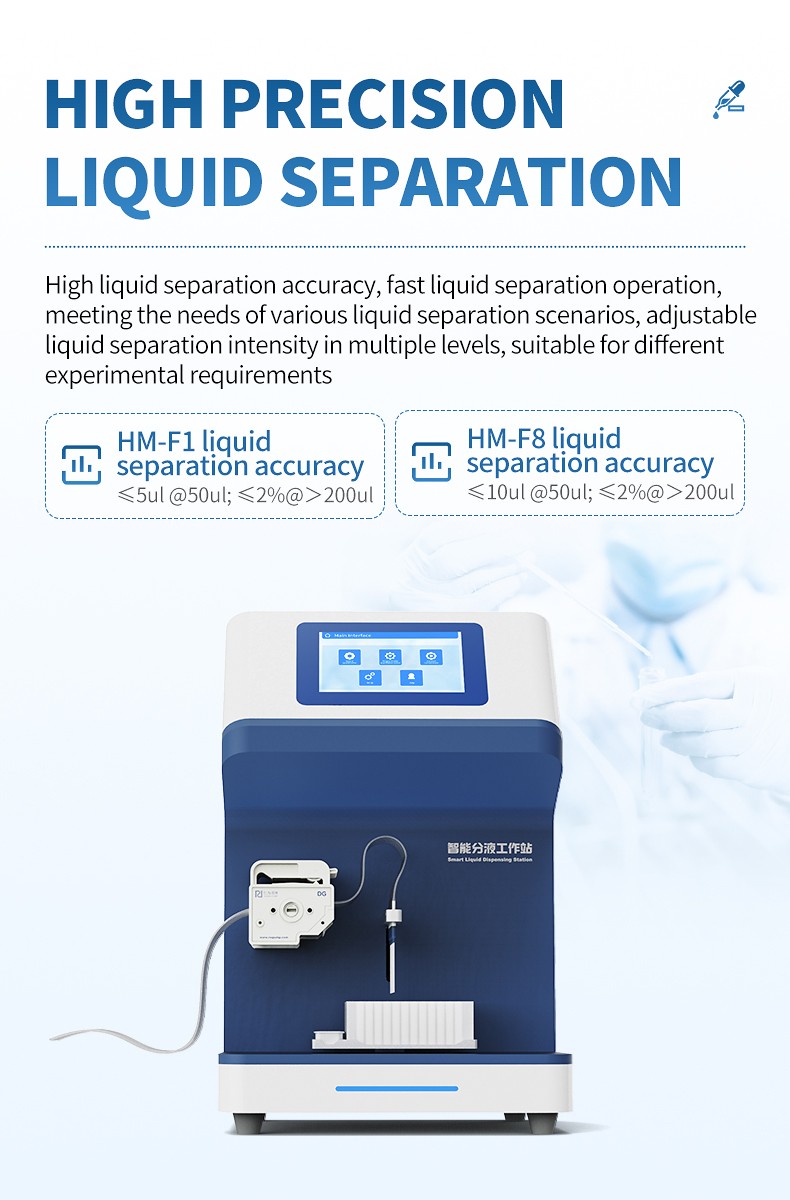
The HM-F1 single-channel automatic micro dispensing station addresses exactly this class of work. Its YZ-15A peristaltic pump head delivers ≤5 μL accuracy at the 50 μL reference point — the tightest specification in the HM dispensing series — and holds errors within 2% above 200 μL. The single needle addresses each vessel individually: volumetric flasks for standard preparation, tube strips for serial dilutions, reagent bottles for media supplementation, or individual wells when a plate layout demands unique per-well volumes.
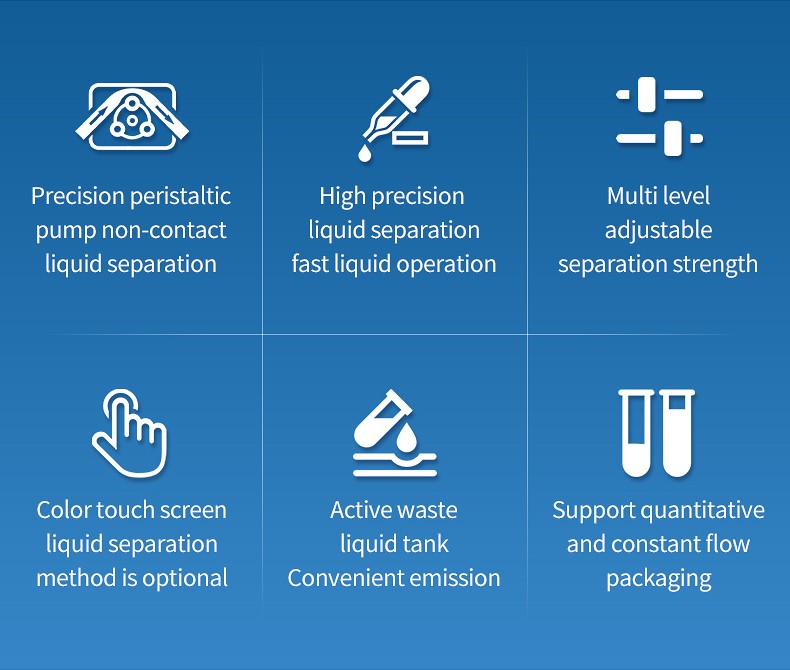
Because peristaltic pumping is non-contact, liquid never enters the instrument. Each batch runs through fresh platinum-cured silicone tubing (OD 4 mm × ID 0.8 mm, rated -51 to 238°C) that can be replaced or autoclaved between reagents — eliminating the carryover risk that shared-tip and shared-reservoir systems carry. Ten programmable recipes with 32 column volumes each let a laboratory lock its dispensing protocols into the 7-inch touchscreen, removing operator-to-operator variation permanently. Calibrated to JJF (Ji) 233-2024 and JJF 1259-2018 and independently verifiable by the ISO 8655 gravimetric method, the HM-F1 provides the documented traceability that method validation requires — detailed answers to common engineering questions are collected in our dispensing station technical FAQ.
Applications
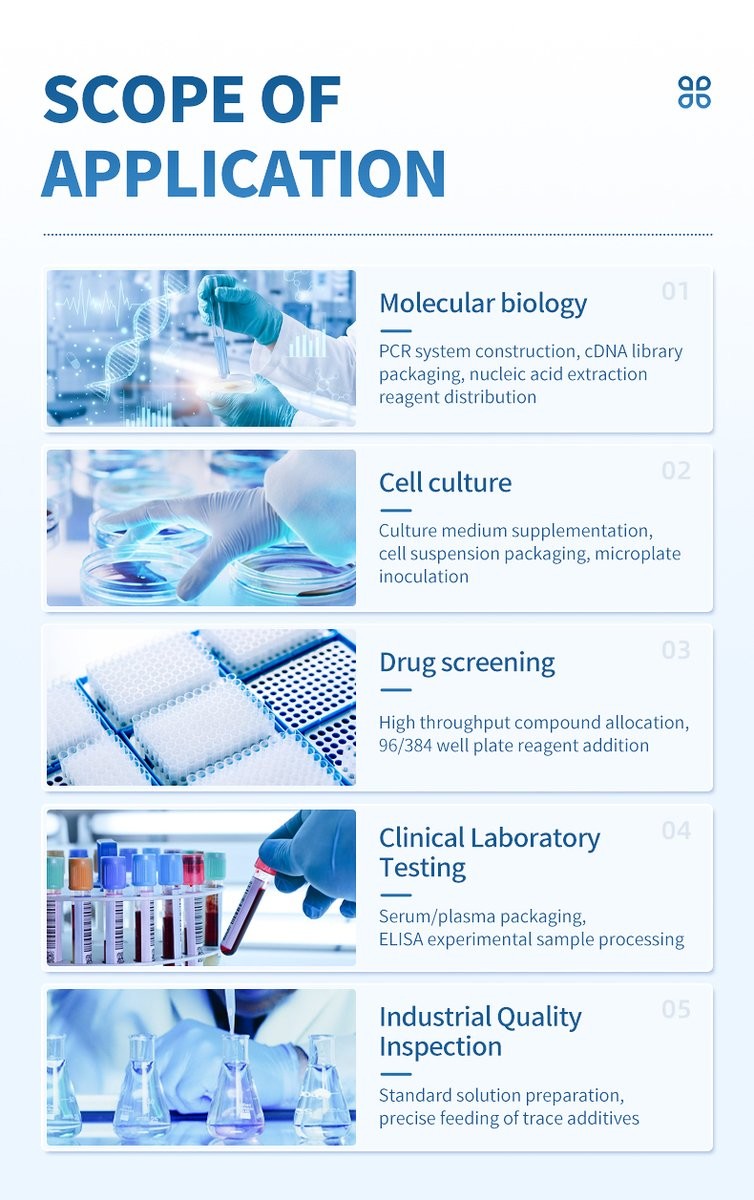
- Standard solution preparation: dispensing precise spike volumes into volumetric flasks tightens calibration curves and reduces out-of-spec investigations.
- PCR/qPCR master mix aliquoting: consistent microliter aliquots protect Ct reproducibility in low-copy assays.
- Serial dilution: per-tube programmed volumes build standard curves without manual volume tracking.
- Nucleic acid extraction: lysis and wash reagent distribution with zero carryover between batches.
- Cell culture supplementation: single-needle access into flasks and bottles of varying neck sizes for precise additive dosing.
- Clinical aliquoting: serum and plasma distribution with a fresh, contamination-free fluid path per batch.
- Bulk bottling: constant-flow mode fills reagent kits and bottles with unlimited volume at 600 rpm.
Key Features & Advantages
- Series-tightest accuracy — ≤5 μL at 50 μL reference point, ≤2% above 200 μL, suited to analytical-grade dispensing.
- YZ-15A precision pump head — single-channel peristaltic delivery at up to 600 rpm with multi-level strength adjustment.
- Structurally contamination-free — liquid contacts only replaceable platinum-cured silicone tubing; no internal fluid path exists.
- 20 μL minimum volume — covers microliter assay work through milliliter bottling on one instrument.
- Programmed standardization — 10 recipes × 32 column volumes lock protocols into the instrument, removing operator variance.
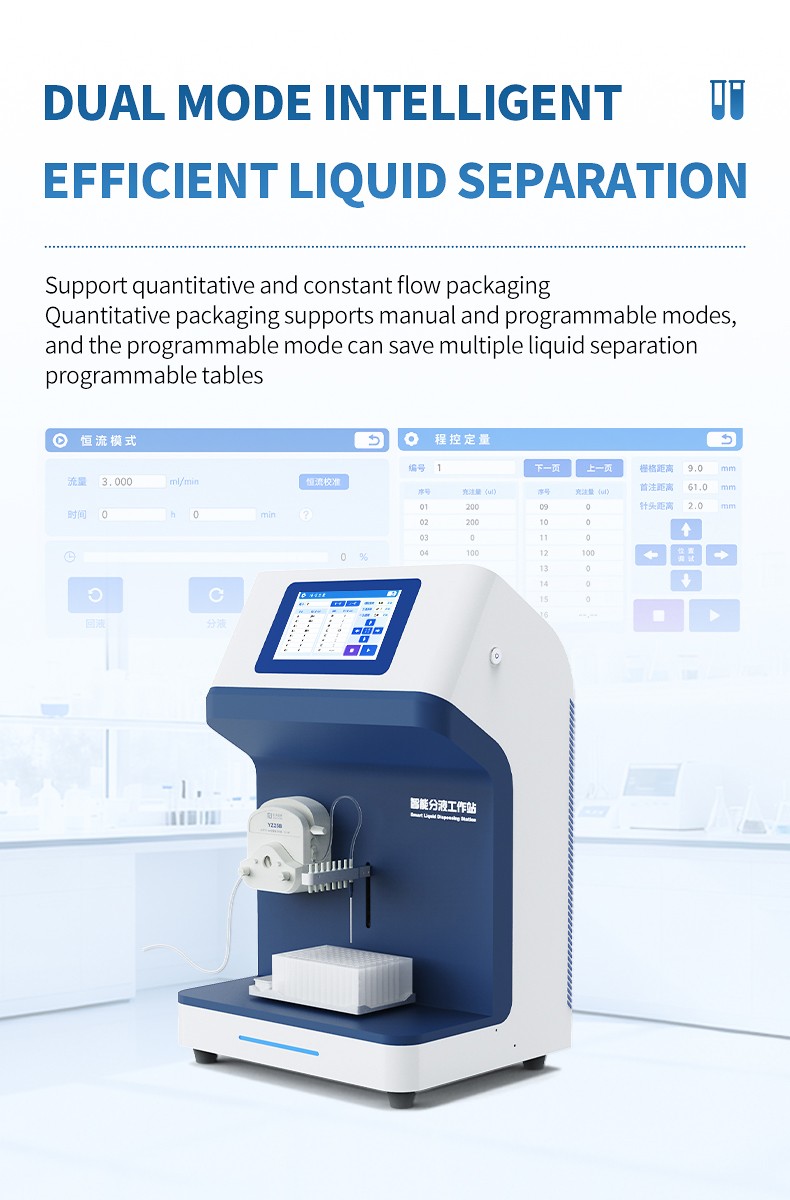
- Dual dispensing modes — quantitative up to 9,999,999 μL; constant-flow unlimited for bulk filling.
- Gentle handling — adjustable dispensing strength protects fragile cell suspensions and handles viscous reagents.
- Reagent recovery — back-suction returns unused reagent from tubing to the source container.
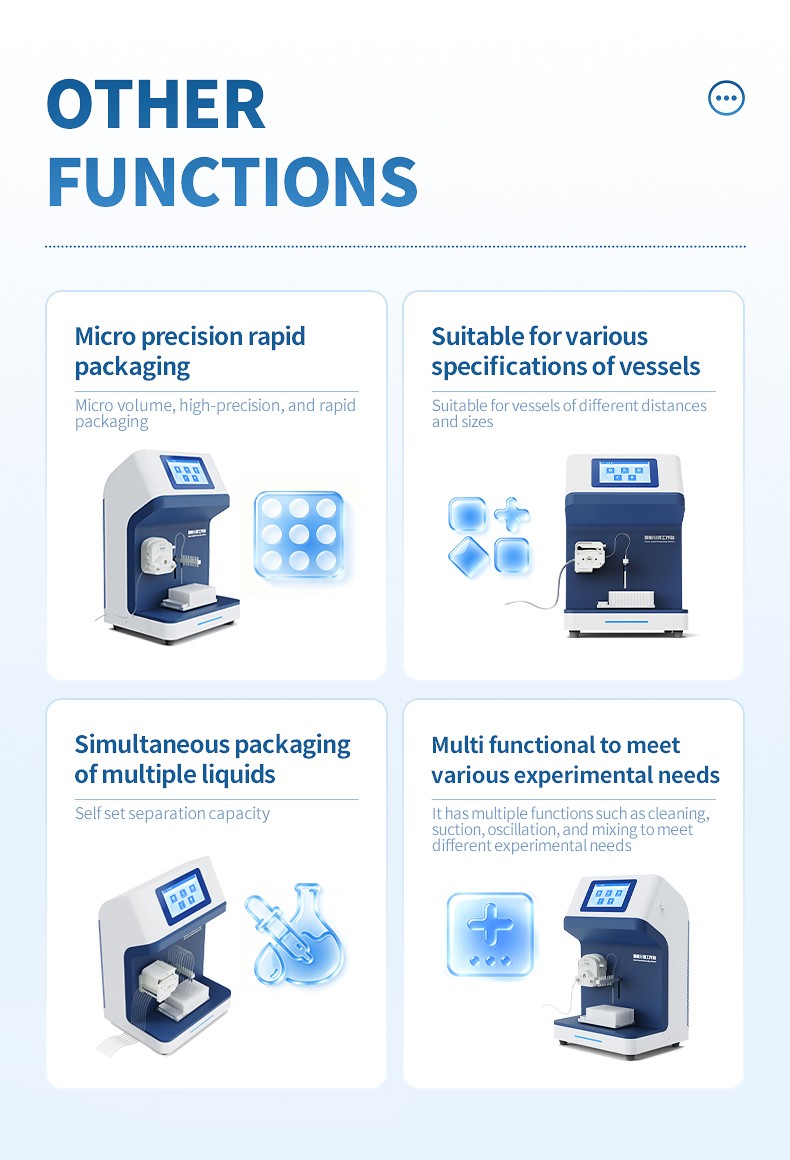
- Flexible vessel access — adjustable needle rack and 110 mm rack height accommodate tubes, flasks, and bottles.
- Lowest consumable cost in its class — standard silicone tubing replaces proprietary tips and cassettes.
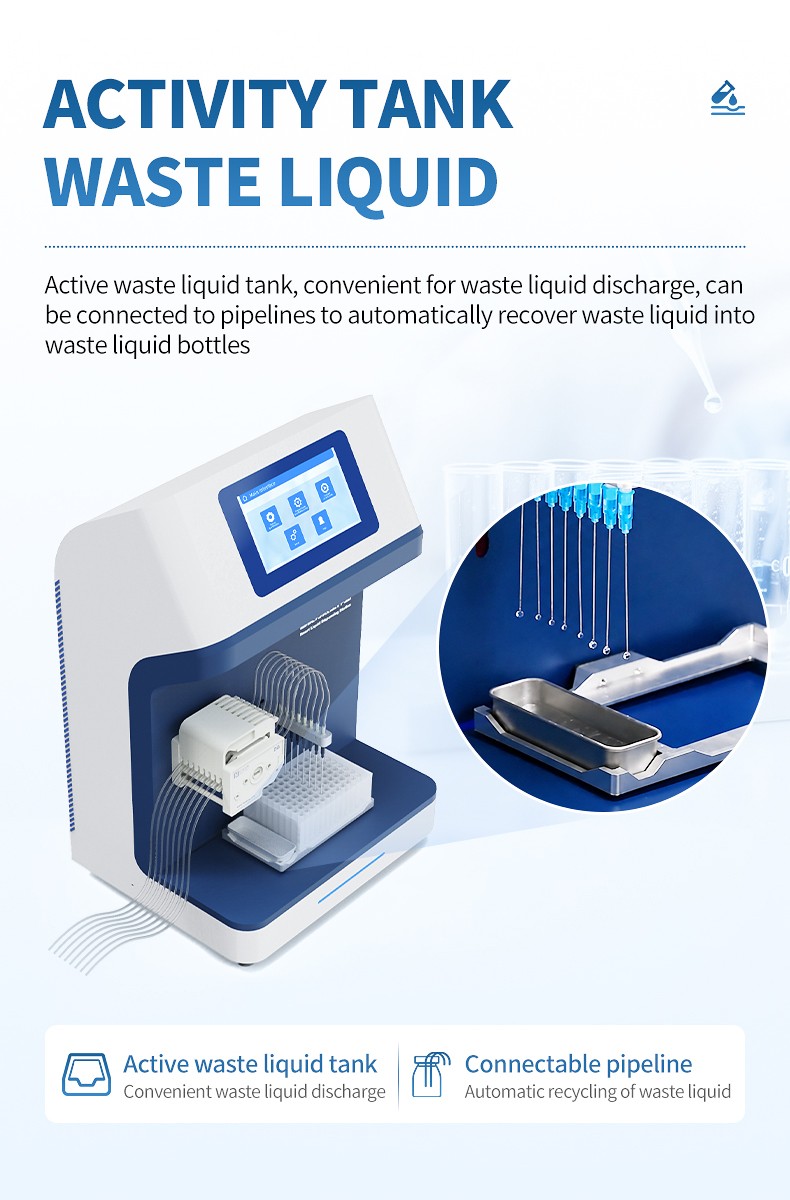
- Unattended wash cycles — removable waste-liquid tank with drain-line connection.
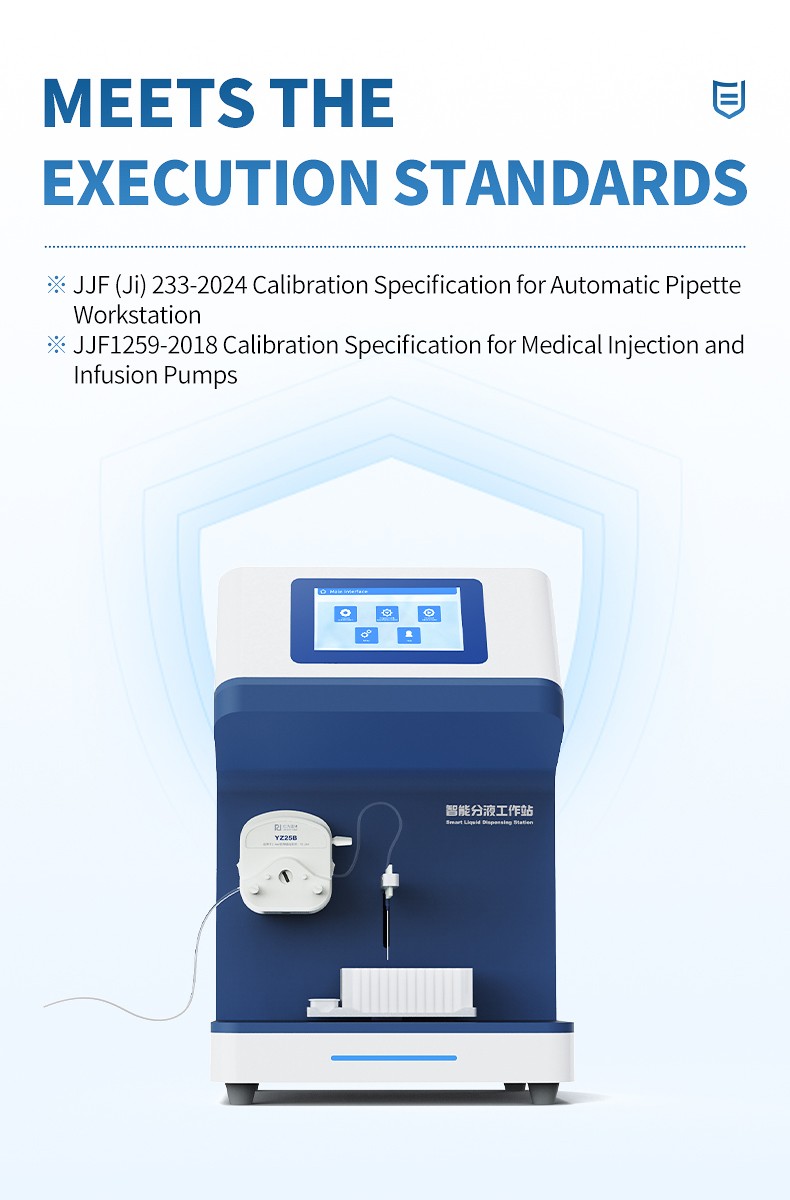
- Documented traceability — JJF (Ji) 233-2024 and JJF 1259-2018 calibration supports ISO 15189 and ISO/IEC 17025 quality systems.
- Benchtop-friendly — under 60 dB, 355 × 280 × 550 mm, DC 24 V 100 W supply.
Technical Specifications
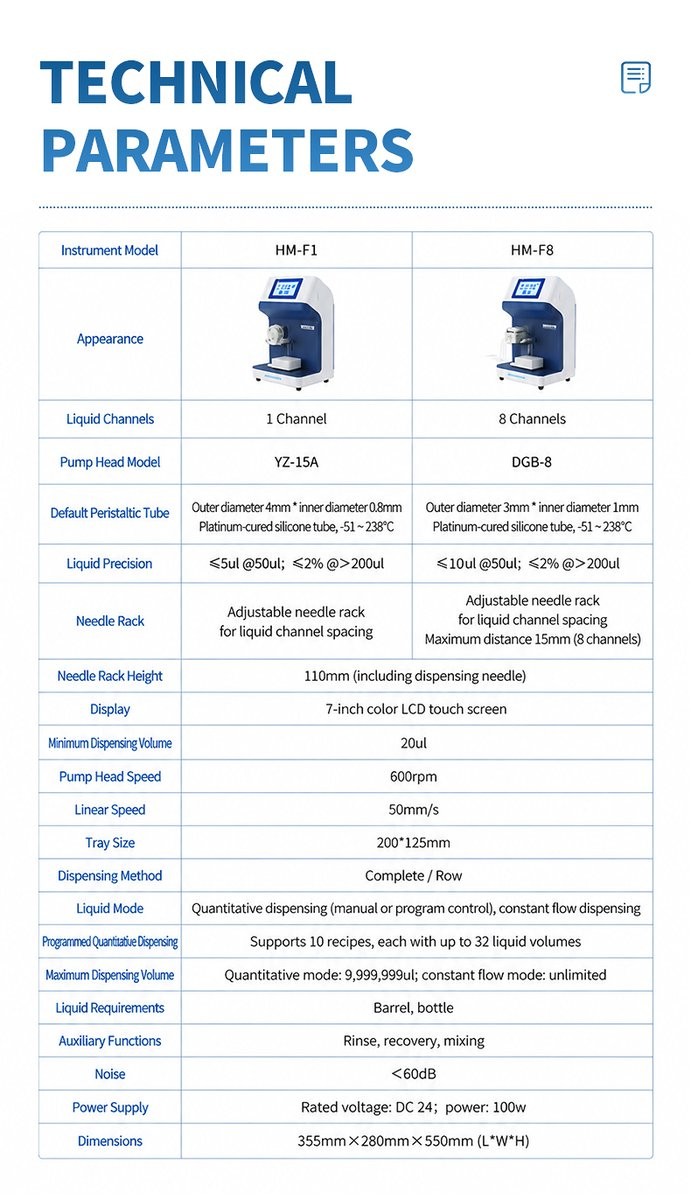
| Specification | HM-F1 |
|---|---|
| Dispensing channels | 1 |
| Pump head | YZ-15A |
| Minimum dispensing volume | 20 μL |
| Accuracy @50 μL | ≤5 μL |
| Error above 200 μL | ≤2% |
| Default tubing | OD 4 mm × ID 0.8 mm platinum-cured silicone |
| Needle rack | Adjustable spacing |
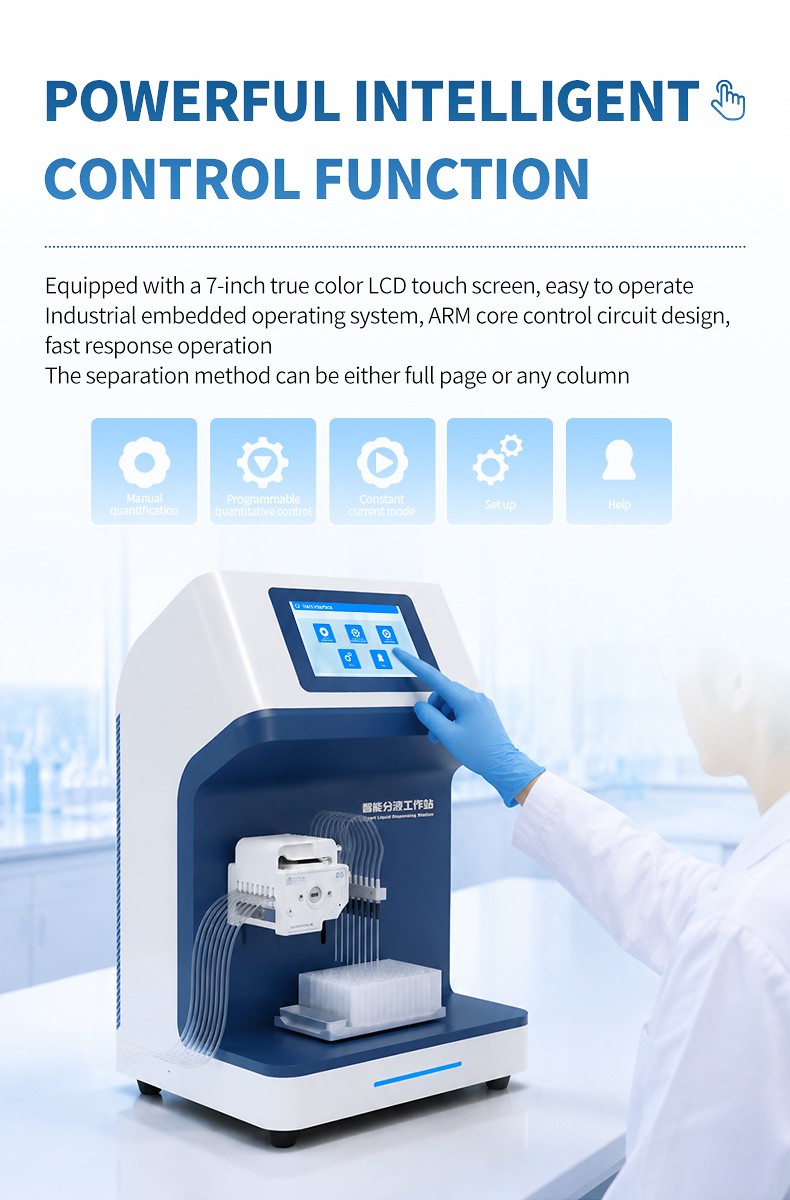
| Display | 7-inch color touchscreen |
| Dispensing modes | Quantitative (manual/programmed), constant-flow |
| Program memory | 10 tables × 32 columns |
| Max quantitative volume | 9,999,999 μL |
| Dispensing strategy | Whole-plate / any-column |
| Pump speed | Up to 600 rpm |
| Linear speed | 50 mm/s |
| Tray dimensions | 200 × 125 mm |
| Needle rack height | 110 mm |
| Liquid source | Bucket or bottle |
| Auxiliary functions | Rinsing, back-suction recovery, mixing |
| Noise | <60 dB |
| Power supply | DC 24 V, 100 W |
| Dimensions | 355 × 280 × 550 mm |
| Calibration standards | JJF (Ji) 233-2024; JJF 1259-2018 |
FAQ
Q1: What accuracy does the HM-F1 achieve at 50 μL?
The HM-F1 achieves ≤5 μL at the 50 μL reference point — the tightest rating in the HM dispensing series — and maintains ≤2% error for volumes above 200 μL. These are calibrated values, not estimates: the instrument ships calibrated to JJF (Ji) 233-2024 (automatic pipetting workstations) and JJF 1259-2018 (medical injection and infusion pumps). Laboratories can independently verify performance at any time using the ISO 8655 gravimetric method: dispense replicate volumes into a weighing vessel on an analytical balance, convert mass to volume using liquid density, and compare the mean error against the published limits.
Q2: When should I choose the single-channel HM-F1 instead of an 8-channel model?
Choose the HM-F1 when your work is vessel-by-vessel rather than plate-based. Typical cases: preparing standard solutions in volumetric flasks, building serial dilution series in tube strips, supplementing media in flasks of different neck sizes, or filling irregular containers where a fixed multi-needle rack cannot reach. The single channel also delivers the series' tightest accuracy (≤5 μL at 50 μL versus ≤10 μL for 8-channel designs), so low-volume analytical work benefits directly. If your daily workload is filling entire 96-well plates, the 8-channel HM-F8 is the better fit; many laboratories run both.
Q3: How does the HM-F1 prevent cross-contamination between samples?
The HM-F1 uses non-contact peristaltic pumping: the pump rollers compress the tubing from outside, so liquid only ever touches the inner wall of the platinum-cured silicone tube. There is no internal fluid path, valve, or shared tip inside the instrument. Between reagents or sample batches, operators simply replace the inexpensive tubing — or autoclave it, since the material tolerates -51°C to 238°C. Built-in rinsing and back-suction recovery functions clear and drain the line between runs, so priming and washing require no extra accessories and produce no residual carryover.
Q4: Can the HM-F1 handle viscous reagents or fragile cell suspensions?
Yes. The peristaltic mechanism has no valves or seals in contact with the liquid, so viscosity does not stress internal components, and the 600 rpm pump head with multi-level adjustable dispensing strength lets operators tune the flow profile: slower and gentler for live cell suspensions to protect viability, stronger for viscous liquids such as glycerol-containing buffers or concentrated media. The platinum-cured silicone tubing tolerates a wide temperature range (-51 to 238°C) and resists aggressive formulations; when switching between incompatible reagents, the tubing is simply replaced at minimal cost.
Q5: What routine maintenance does the HM-F1 require?
Maintenance is minimal by design. Daily care consists of running the built-in rinsing function with an appropriate cleaning solution and using back-suction recovery to clear the tubing after work. The silicone tubing is the only routine consumable and is replaced in minutes without tools. Periodic gravimetric verification against the JJF calibration specifications keeps accuracy documented for quality audits. There are no pistons, seals, or syringes to service. HM Instruments backs the instrument with a one-year warranty, lifetime technical support, free control-software upgrades, and spare-parts availability for at least 10 years after discontinuation.
Address of this article:https://www.labinstruments.net/liquid-dispenser/hm-f1-precision-liquid-dispensing-laboratory.html
- Previous: no more
- Next: 8 Channel Micro Dispensing Station for 96-Well Plate High Throughput